Hot Day at Formentera
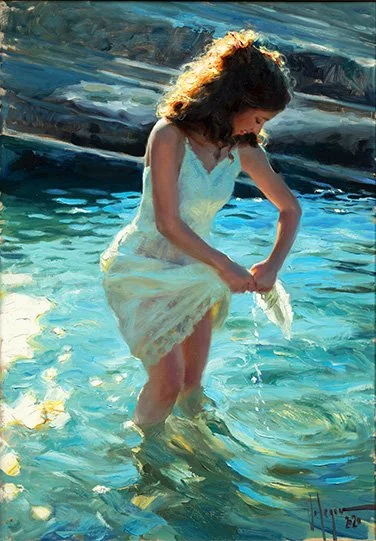
Some time ago, before skinny palms and the air in Gloom City, I discovered the works of a still-living artist worthy of museums and art houses. That artist is called Vladimir Volegov, whose works spoke to me in a familiar language. His subjects tend to be of the feminine, often women in the springtime of their lives in settings of beaches or Spanish cities still set in cobblestone, where the villas are sparsed like raindrops on a window pane, the foliage that grows from clay cauldrons sits on their sills while the people loiter outside on steps or railings. Who are they to waste such a day?
Beauty never needed a backstory, but it brings me joy to create scenarios that might implicate subjects in deeper respects than their artist may afford them. The point is, one cannot know unless it is stated or you query the artist directly. What good are words, after all? Those are the things that bog us down in particulars and distract us from the beauty. Paint on canvas is an honest retelling of what a novel could never contain. Words are insufficient; it is in a brushstroke that truly satisfies. Once a word is jotted, another is demanded and another after that. The writer decides when enough is said, while the painter grows closer to the truth with every swipe and smudge, with every dab and touch. No matter my efforts, I can never write a sentence impasto. I am confined to the linear, while the painter chooses his starting point. He may begin in the corner of his canvas or dead in the center.
A framed print of Hot Day at Formentera hangs on my wall and often I listen while it says more than words can illustrate; the brilliance and brightness of blue commandeer word choice and adjective, overshadowing sound and tongue-smacking.
A playful moment framed and eternalized in oil on canvas, a collection of chemicals that tell the story of our female subject. She stands in the shallow, wringing out her dress of white linen. I imagine she’s spilled a drop of wine or bounced a grape seed against the lower section of her skirt, and now, in an effort to prevent a stain, she rushes to the water a few paces from their picnic blanket. He’s followed her in an effort to console but also to poke fun at her carelessness and the ease with which she finds herself with him. He cherishes the moments when she is most vulnerable and child-like, slightly embarrassed. Blushing, she is failing to boycott his jeers. He won’t stop; he is just a fool in love. From his perspective we see our subject. We see the slight smile on her face, and as she wrings the dress further, our painting captures the moment in time but, more importantly, imparts something in the audience that, while entirely relatable, is also exclusive: a moment unrepeatable and unique. It is theirs only, and to view it in frame is as close as we can hope to get.
She stands in water knee-high, wringing still, laughing in protest. The sun is beating down against her frizzed hair. It was a hot day that day, their day, in the Balearic Sea, on an island made for them. The dress could be her mother’s favorite or on loan from her sister, and truthfully, the dress matters not. She is concerned with her place, her station, her love. No longer do ramifications and repercussions sting her; she is free in the water, watched closely by her love, and despite his playful ribbing she is completely at peace. I imagine Volegov spent the majority of his time on her half open eyes as they become more than just eyes; they are her windows into which we can peer and, upon inspection, find something supernatural, yet an experience we all have a right to live in and create. We exist to love and love more than just romantically, but to love intentionally and love in our actions like our subjects love each other. He followed her to the water, and he would follow her to hell if she desired to go. It’s the playful moments of love that promise to endure in moments where risk of injury or harm are most promised but forgone as necessary to carry out the conditions that love places upon us.
Love is a painting, and lust are the words of writers and scribes, copyists, and penmen. We are insufficient. Words are what we use to rationalize and contemplate; we talk ourselves out of what we know we ought to do while failing to attempt. Words create worlds in our imagination, while a painting delivers us fully. Words contort like somersaults and handsprings, while a painting lays flat, approachable, and neutral. To paint is to speak a language universal that the smallest mind and biggest of brain can understand intently. Words prohibit and gatekeep, lacking an honest description; a lie is best hidden behind the blades of polysyllables. A painter cannot lie; he is immune to the temptation, while the writer falters at a loss for color or in the holes of pegboard sentence structure. Every writer is a failed painter, every sentence a failed collection, every word a failed brushstroke.
Hot Day at Formentera - Volegov (2020)